

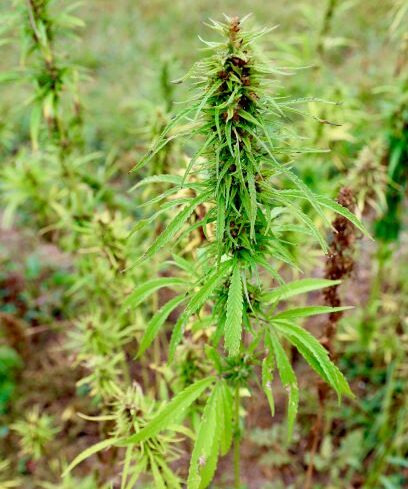
Our research focuses on the emission, transport, and impacts of bioaerosols—including pollen, plant pathogens, and agricultural pests—and their implications for human health and agricultural productivity. We integrate field measurements, laboratory experiments, remote sensing, and atmospheric modeling to understand how biological particles move across scales and influence exposure, disease spread, and crop outcomes.
Our work has enabled regional-scale predictions of wind-dispersed pollen and assessment of cross-pollination risks. We mapped wind-borne Cannabis pollen across the U.S. and assessed the risk of unintentional cross-pollination. Our manuscript on this topic was among the Top 100 most downloaded Scientific Reports research papers of 2024.
Beyond pollen, our research expands to bioaerosol threats to agriculture. As part of the DARPA-funded AgSENT project, we contribute to identifying atmospheric “gateway” conditions that enable long-range transport of bioaerosol threats, supporting early warning systems for agricultural security.
Our lab also contribute to a NASA-supported effort to develop next-generation pollen forecasting systems. This work combines phenology observations, remote sensing, and atmospheric dispersion modeling to predict allergenic pollen (e.g., Juniperus ashei) and quantify links to respiratory health outcomes.